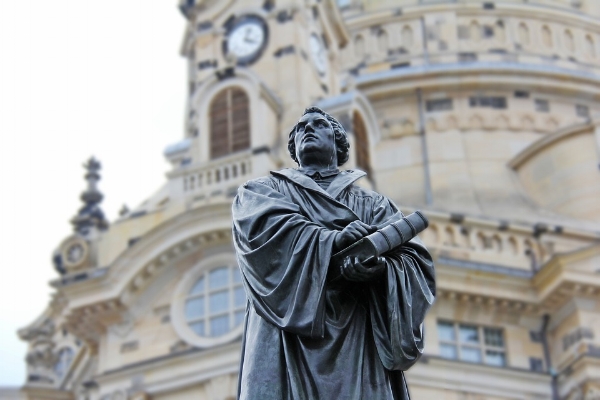
Reformation Reflections: Your Work Matters

In honor of the 500th anniversary of the Protestant Reformation, I'm taking some time to reflect on what the Reformation means today. If you'd like to learn more about the Reformation, see my post "Protestant Amnesia: What's So Important About the Reformation?"


At the time of the Reformation, there was a strong divide the “religious” and the “secular” person. There were those who had experienced the call (or been forced into it), and there were regular folks. There were priests and monks and nuns—and then there were the butchers, the bakers, and the candlestick makers.

There was a shared belief that those in the religious life were doing important spiritual work and had their entire existence set apart for God’s service. Everyone else was bogged down by responsibilities, shackled to earthly things like family and work. They could never aspire to be as holy as those in the religious life, and they were dependent on them, as people who were closer to God than they could ever be.

The Reformation turned this paradigm on its head. Monks and nuns were being called to leave their cloistered lives—and to marry. (Please do not underestimate how scandalous this was.) The early leader of the Reformation, Martin Luther, a former monk, married Katherina von Bora, a former nun, who escaped her convent hidden amidst old fish barrels. They were “tied down” with family life, with children, with guest lodgers, with scraping together an income. Instead of a lesser station, the Reformers saw family life, particularly the raising of children, as a godly and noble undertaking.

schuster-2060668_960_720.jpg

The same was true of our work. At the time, “vocation” was used to describe the sacred calling of monks and nuns. But Luther extended it to include normal, ordinary people, who also had a vocation—a calling—in their work. The work of the every day Christian—the plowing, the diaper-changing, the shoe making—matters.

The commonplace details of our lives aren’t to be escaped or retreated from. They are sanctified as we use them to better love and serve our neighbors. This love of neighbor is what glorifies God—not whether or not our work is explicitly religious.

Luther would say:

“The prince should think: Christ has served me and made everything to follow him; therefore, I should also serve my neighbor, protect him and everything that belongs to him. That is why God has given me this office, and I have it that I might serve him. That would be a good prince and ruler. When a prince sees his neighbor oppressed, he should think: That concerns me! I must protect and shield my neighbor....The same is true for shoemaker, tailor, scribe, or reader. If he is a Christian tailor, he will say: I make these clothes because God has bidden me do so, so that I can earn a living, so that I can help and serve my neighbor.”

So, my friend, if you go to work today with an awareness that your work is a calling, that through your normal life you can glorify God, you have the Reformation to thank. 

If you find yourself subtly thinking that your “secular” work is less-than or a distraction, that the most important work is the explicitly “sacred” work in full-time ministry—I invite you to embrace what the Reformers reclaimed for us. That our God is one of the ordinary. That our work matters. That work is a sacred opportunity to fulfill the greatest commandment to love God and love our neighbor. That all of our existence is worship and an opportunity for ministry. That all of it can be made holy. 

Soli Deo Gloria.

Literary Genres in the Bible and Why They Matter for Bible Study

This post is part of an ongoing series on reading, interpreting, and studying the Bible. Click here for all the posts in this series.


When you read a story to a child, do you read it the same way as you would an encyclopedia article? Do you read the newspaper the same way you read a poem? 

We instinctively know that we can’t read everything the same way. The style and form—or genre—of what we’re reading shapes our expectations and interpretation. The genre gives us reading "rules."

If we look for metaphors and deeper layers of meaning in an instructional manual, we’d be missing the point. Likewise, if we expect a children’s storybook to give us nuanced answers for our self-help predicament. We pay attention to genre to read well.

Genre and How We Study the Bible

Do you know the Bible contains several different literary genres? As we read and interpret Scripture, we must pay attention to it to read well and read the passage as it was intended to be read. 

When you read a passage of Scripture, ask, “What is the genre of this book/passage? How does that genre inform the way I should read, interpret, and apply this?”

book-2604453_960_720.jpg

One of the best single resources I know for this endeavor is How to Read the Bible for All Its Worth, by Gordon Fee and Doug Stuart. This book is well worth having on your shelf.

For each of the genres in Scripture, the authors explain the main features of the genre, the Biblical books it applies to, and the basic principles for reading and interpreting the genre. They keep everything practical and accessible, focus on broadly applicable principles that can guide our reading, and pepper these principles with examples. 

For our purposes here, I’ll give a brief overview of the biblical genres—but I’d encourage you to get a copy of How to Read to learn more.  

Biblical Genres At A Glance

Narrative 

The narratives in the Bible tell us about God’s work in history. These stories from the past are intended to shape us in the present, but they are not intended to be moralized. They may illustrate implicitly a principle or standard of morality (positively or negatively) that is explicitly taught somewhere else in Scripture, but they do not always give us a clear judgment of people’s behavior.  

Law

The Law was a binding covenant, or legal agreement, between Israel and God, and explains how the nation of Israel was to behave and worship, individually and as a society. It included specific blessings and curses that would come as a result of their faithfulness or unfaithfulness (see Deut. 28). These blessings and curses are important to understand the rest of Israel’s history, particularly the prophets and the exile. 

Poetry

Poetry uses evocative and imagery-laden language and is peppered with metaphors and similes. The Psalms (the largest collection of poetry in the Bible) are songs and poems to and about God, intended to give voice to the praise and prayer of God’s people. They are music, not in-depth or extensive explanations of doctrine. They are properly interpreted as a whole, with each line understood in light of the ones around it. 

One feature to keep an eye out for: parallelism. The writer puts two lines of poetry in parallel with each other, to add a depth of meaning—and beauty—by the way they compare to each other or build on each other. Once you start looking for it, you’ll see how frequent it is. For example, Psalm 19:1:

"The heavens declare the glory of God, 
And the sky above proclaims his handiwork."

Wisdom

Wisdom literature in the Bible uses poetry to give practical, pithy statements about how to make godly choices and think and act based on God’s truth. By nature it is inexact and not exhaustive. It gives us a memorable snippet of truth but doesn’t tell us all about it. This is why all wisdom literature must be read and interpreted based on the entirety of Scripture.  

Prophecy

The prophets spoke for God to specific people in a specific situation. They announce God’s enforcement of the covenant, as given in the Law, and declare both judgment and hope. They must be read in light of the historic setting and background of the audience and in light of the blessings and curses of the Law. The prophets often convey their message using poetry, so we should remember to pay attention to the imagery, metaphors, and parallelism in their message, just as we do in the Psalms. 

Gospels

The Gospels are selective presentations of the life, work, and teaching of Christ, for a specific audience. The differences in the Gospels are intentional, and paying attention to these differences will help us understand what is being emphasized and communicated by each Gospel writer. Just as we pay attention to the intended audience of the Gospel writer, we pay attention to the audience of Jesus’ teaching. His parables and stories expect a response, and they are properly understood when we remember who he is calling to respond in that moment (disciples, crowds, Pharisees, etc.).

Epistles

The Epistles were letters written by apostles to a specific group of Christians for a specific purpose and to a specific situation. Since we’re only given one "side" of the conversation, we need to pay attention to the historical context and to the clues we’re given about the “other side” of the conversation. It’s crucial to read these books with an eye for the entire argument and flow of logic. We must constantly be asking what the author’s words would have meant to his original audience, and then (and only then) we can consider what a comparable situation and application it has for today.

Apocalyptic

The word apocalypse means “revelation, disclosure, unveiling” and refers to an unveiling of unseen or future spiritual or earthly events and realities. It heavily uses symbolism and visions, and it is concerned about future judgment, justice, and salvation. It is important to remember that apocalypse (which appears in Revelation, Daniel, and prophets like Ezekiel) is a form of literature, and one that is heavily stylized and artistic in its imagery, use of numbers, structure, etc. 
 

Protestant Amnesia: What's So Important About the Reformation?

My friend recently posted on Facebook about this year’s 500th anniversary of the Protestant Reformation. It was short, sweet, simple. 

Someone commented calling the post gibberish and my friend a history nerd. 

It was all in good humor—a friend teasing another friend—but I was shocked. I was shocked because the words were coming from a fellow Christian, and a fellow Protestant Christian, and she had no sense of the Reformation’s significance. 

I know she isn’t alone. 

It’s been said that Christians have very bad memories. (I would say this is generally true of humans.) We easily forget where we’ve come from. We forget our history. We forget that our present was birthed from the past. We are heirs of the ideas and decisions of the people and cultures that came before us. We did not emerge from nothing, ex nihilo. We are irreparably tied to our history.

History matters—not because of nerdiness and not for obsession with fact-collecting. History matters because it reminds us who we are. 

How does this relate to the Protestant Reformation? 

At the time of the Reformation, there was one Church in Western Europe—the Roman Catholic Church, and one Church in Eastern Europe—the Eastern Orthodox Church. It’s hard to imagine today, when we’re accustomed to a variety of church traditions. In my hometown and its surrounding township, for example, there are dozens of churches, and I can’t begin to list the various denominations these churches represent.

If you attend a church of any tradition aside from the Roman Catholic or Eastern Orthodox churches, you are a child of the Protestant Reformation. (In many ways, Western history as we know it, including my native United States culture, is also a child of the Reformation, but that goes beyond the scope of what we can talk about here.)

This year marks the 500th anniversary of the Protestant Reformation. In honor of the occasion, I’ll be taking the next few weeks leading up to "Reformation Day" on October 31 to reflect on how the Reformation speaks to us today. But first, we need to cover some basic history.

Martin Luther and Reformation Beginnings

The Reformation started with a monk named Martin Luther. He was obsessive and anxious, hyper-aware of his sin and fearful of God’s judgment. As a professor at Wittenberg University, Luther threw himself into the study of Scripture.

As he studied and lectured, he gradually began to see the Bible's teaching differently. God's righteousness, like it's talked about in the book of Romans, isn't about God waiting to smite us. It's about God's gracious gift in making us righteous because of the death and resurrection of Jesus. He gives us His righteousness, bringing us to a place of right relationship, adopting us as His children. And He does this not because of our own merit or worthiness or action but merely by His grace, through our faith in Christ. 

martin-luther-617287_960_720.jpg

For any of us who grew up in a Protestant church, this probably sounds like old news. But for Luther, it was revolutionary. He “rediscovered” this presentation of the Gospel, which now sounds so common to us. It was his reformation breakthrough.

The trouble started when Luther wrote and posted the Ninety-Five Theses in 1517. At the time, traveling preachers were selling indulgences. They told townspeople, often poor peasants without money to spare, that if they paid money for an "indulgence," one of their loved ones would be released from Purgatory. They even had an advertising jingle: “As soon as a coin in the coffer rings, the soul from Purgatory springs.” 

Luther was a concerned pastor. He saw a practice that was taking advantage of poor churchgoers, a practice that was theologically suspect in suggesting people could buy salvation, a practice that was conveniently funding a grandiose building project in Rome. So, he wrote ninety-five objections to the practice and publicly shared them for scholarly debate. 

The Ninety-Five Theses circulated widely and quickly, and controversy erupted. The next few years were a whirlwind for Luther. He wrote furiously, explaining the theological views that had slowly been forming during his studies. He publicly debated church leaders and stood before religious and secular councils. He was eventually declared a heretic, excommunicated from the Catholic Church, and made an outlaw. But the “damage” had already been done. The Protestant Reformation was taking Europe by storm. 

Reformation Basics: The Solas

I will not take the time to explain all that Luther did and taught for the rest of his life. And I will not detail his followers and the various early fragmentations of the Reformation. If you’re interested, this information is readily available elsewhere. Instead, I want to simply explain the Reformation distinctives, these significant shifts that revolutionized the expression and theology of the Christian Church. We call them the “solas.”

Sola Scriptura: Scripture alone is the highest authority.

This was the starting point of the revolutionary shift of the Reformation. No longer did the judgments of popes or church councils or the traditions of the church bear the authority of what was true. Scripture alone was the judge and standard of truth. It is the authority for our faith and doctrine, and everything must be interpreted in its light.

Solus Christus: Christ alone is our only mediator to God.

We could not come to God on our own, and we needed Him to reveal Himself and come to us. Christ alone is the way for us to be in right relationship with God and know what He is really like. Our salvation was accomplished once and for all by the life, death, and resurrection of Jesus Christ. He is the only way of salvation. 

Sola Fide & Sola Gratia: We are saved through faith alone, by the grace of God alone. 

It is impossible for us to save ourselves or work our way into God’s favor. Our salvation is entirely by His grace, not by any works or good things we have done. We do not add to the saving work of Christ—He has already fully won our salvation. We receive this salvation and are made right with God by responding in faith to what Christ has already done. In a “great exchange,” the penalty of our sin was paid by Christ on the Cross, and we are given His righteousness, declared to be right with God. The simple statement of the Gospel, which we have inherited from the Reformation is: Justification (we are made right with God), by grace alone, through faith alone, because of Christ alone.

Soli Deo Gloria: Glory to God Alone

God alone receives glory from our salvation and our lives. Because salvation is entirely His work, and not our own, He receives all the glory and praise from it. The whole of our lives should be lived for His glory.

Luther never wanted to break from the Catholic Church. His intention was always reform—to call the Church back to its roots, back to the basic teachings of the biblical Gospel. But the reformation turned into a break, and produced a new branch of Christianity. This year, we mark its 500th birthday.

Let Them Be One: "A Reforming Catholic Confession"

Jesus is staring down a death of shame and torture on the cross, and He stops to pray. He doesn't simply pray for himself - He prays for His disciples, and all who would become His disciples. In the shadow of the cross, Jesus prayed for us. And of all the things He could have prayed for in that moment, He chooses one that continues to convict me. He prays for unity. 

"I have given them the glory that you gave me, that they may be one as we are one—I in them and you in me—so that they may be brought to complete unity. Then the world will know that you sent me and have loved them even as you have loved me." (John 17:22-23)

Jesus sees power in the unity of His disciples. This unity, this oneness in the Body, demonstrates to the world who He is. It puts His love on display. 

When I see unity in the church, when differences can be just that—differences—and not a source of division, it makes my heart swell with joy. 

I want to share such a unifying effort with you. It has me excited. 

In honor of the 500th anniversary of the Protestant Reformation, a group of Protestant theologians and scholars came together to draft "A Reforming Catholic Confession." [Fun fact: One of my beloved professors and the adviser of my seminary program was one of the drafters!] This confession of faith is "reforming" in the heritage of the original Reformers, meaning it seeks to continually go back to the Scriptures as the judge of truth. It is "catholic" in the sense of the early creed, in its universal scope uniting believers. The Reforming Catholic Confession is a unifying statement of faith of the core beliefs Protestants have in common.

pexels-photo-220580.jpeg

When it was released last month, it bore 250 signatures from church leaders hailing from around the globe and from most Protestant traditions. This diversity was shared by the original drafters. As I write this, the Confession has 1162 signatures.

I would encourage you to read the Confession yourself. It's quite in-depth and beautifully written. Remember as you read, this confession of faith represents "mere Protestantism," or the unifying, interdenominational essentials of the faith according to Protestant traditions. In Explanation of the Confession, they say

"While it is tempting to focus on and exaggerate the differences, we want here to strengthen the Protestant cause by focusing on the doctrinal beliefs we have in common, not least for the sake of our common witness to the truth and power of the gospel."

Some may wish to go further than the Confession in their statement of faith. Some may wish to nuance or clarify certain points. But the point was to clearly define—and celebrate—what we hold in common as brothers and sisters in Christ. We can recognize what we hold in common is more important than what separates us. 

The drafters are clear to recognize and appreciate the "distinctive emphases" of the various Protestant streams. They have no desire to dissuade people from differing opinions or to claim those differing matters to be unimportant. But the drafters beg for these differences to be worked out in the context of discipleship and right relationship. I thought the wording was eloquent: 

"We recall and commend John Wesley’s plea...for right-hearted believers to give up their prideful insistence on their right opinions in order to establish right relations with others whose hearts and minds are set on following Jesus according to the Scriptures."

"We wish to discuss our remaining differences in a spirit not of divisiveness but discipleship."

And so they have - and now over a thousand others have joined them. And my spirit rejoices. 


If you want to learn a bit more about A Reforming Catholic Confession, I'd encourage you to read this article from Christianity Today. 

Reading the Bible in Context: Part 2, The Big Picture

This post is part of an ongoing series on reading, interpreting, and studying the Bible. Click here for all the posts in this series.


I have yet to meet anyone who doesn’t love a good story. We love being caught up in them, swept up in our imaginations, transported to another time. They make us laugh and cry. They inspire us and challenge us to live differently. Stories shape who we are. 

I hope you’ve encountered some good storytellers in your time—the sort that captivate you as they slowly pull you into their tales. 

We cannot forget that the Bible tells us a story. It is a story with a beginning, middle, and end. It tells the grand story Creation, Fall, Redemption, and Restoration. We are a people of this story. We are marked by it. And we have been called to live in it.

pexels-photo-273936.jpeg

To understand the Bible properly, we need to understand its Story. We need to see how the parts of that story fit together. When we’re reading the Bible, we should ask, How does this passage fit into the overarching story of the Bible?

CASKET EMPTY is the best tool I know to explain the biblical story and keep each part of the Bible in its larger framework. CASKET EMPTY was developed by two Gordon-Conwell professors for the purpose of helping people understand the story of the Bible. They’ve used CASKET EMPTY as an acronym to describe the major highlights of the biblical story. This acronym structures the beautiful illustrated timelines for the Old and New Testaments as well as the companion study guides. If you’re looking for a thorough yet accessible overview of the Bible, you really must take a look at these. 

I’ve given broad brush strokes of the Story below, using the CASKET EMPTY framework. Remember that this is a sweeping abbreviation, so you’ll want to read more on your own to fill in the gaps and details.


Old Testament

Creation

Genesis 1-11

God creates the world and everything in it, and it is good. Adam and Eve, the first humans, are deceived in the garden of Eden, and sin enters the world. This “Fall” brings the results of sin and death, including the effects of sin on our relationship with God, with each other, and the with created order.

Abraham

Genesis 12-50, possibly Job

God makes promises to Abraham (see Gen. 12:1-3, 17:1-8) and makes a covenant with him. This covenant continues to his descendants, starting with his miraculous son Isaac and moving to the entire nation of Israel.

Sinai

Exodus, Leviticus, Numbers, Deuteronomy, Joshua, Judges, Ruth

God delivers the Israelite people from slavery in Egypt, with Moses as their leader. He makes a covenant with them at Mt. Sinai and gives them the Law. They enter into the Promised Land, with God promising to dwell with them in the tabernacle.

Kings

1-2 Samuel, 1-2 Kings, 1-2 Chronicles, Psalms, Proverbs, Ecclesiastes, Song of Solomon, Isaiah, Jeremiah, Ezekiel, Daniel, Hosea, Joel, Amos, Jonah, Micah, Nahum, Habakkuk, Zephaniah

God grants Israel a king—first King Saul (which ended badly), then King David. God makes a covenant with David, and his is the true royal line. After David’s son Solomon dies, the Kingdom is divided into Israel in the North and Judah in the south (which follows the rightful line of David). Both Kingdoms stray from God’s Law, though the Kingdom of Judah does have some godly kings, who call the nation back to worship of God alone. Because Israel and Judah have broken the Law, God promises judgment. The prophets write during this time, calling the nations to repentance, announcing judgment, and promising God’s faithfulness. The Kingdoms continue to rebel, however, and God brings judgment through the means of other nations. Israel is conquered by Assyria, and Judah is conquered by Babylon.

Exile

Jeremiah, Lamentations, Ezekiel, Daniel, Obadiah, Psalms

After the Kingdom of Judah is conquered, the people are taken to exile in Babylon. The prophets say that after a time of exile, God will restore His people and bring them back to their land. They also promise the coming of a Righteous King, and a new covenant in which God’s people will be freed from sin and given hearts that are soft to obey Him. 

Temple

Ezra, Nehemiah, Esther, Haggai, Zechariah, Malachi, Psalms

As God promised, the people of Judah are allowed to return to rebuild Jerusalem. They rebuild the city, the walls, and the temple. 

New Testament

Expectations

Between the end of OT and beginning of NT, no Biblical books

The Israelite people continue to wait for the promised Messiah the prophets spoke of, as they continue to face oppression by world powers. 

Messiah

Matthew, Mark, Luke, John

Jesus comes as the Messiah and in his life, death, and resurrection fulfills the promises made to God’s people. He announces the arrival of the Kingdom of God and proves its presence with signs and miracles. He calls people to repentance and a response to the Gospel. Jesus lived a sinless life but died a criminal's death on a Cross. His death paid humanity’s penalty for the effects of sin and death brought on by the Fall and began a restoration of all of Creation. His life, death, and resurrection are the climax and ultimate fulfillment of the Old Testament, and the basis for the Christian church’s teaching in the rest of the New Testament. This is the highlight and center of the Story.

Pentecost

Acts

After Jesus returns to Heaven, his disciples receive the Holy Spirit. They begin to spread throughout the known world, obeying Jesus’ command to baptize and teach disciples in His Name. God makes clear Gentiles (people not of ethnic Israel) and people of all nations are equally welcomed into faith. Fledgling churches spring up and expand, even in the face of persecution. Paul, once a persecutor of the church, emerges as a key leader.

Teachings

Romans, 1-2 Corinthians, Galatians, Ephesians, Philippians, Colossians, 1-2 Thessalonians, 1-2 Timothy, Titus, Philemon, Hebrews, James, 1-2 Peter, 1-3 John, Jude

Leaders of the church write letters to teach early Christians about the effects and implications of Jesus’ life, death, and resurrection. They talk about how new life in Christ and the empowerment of the Holy Spirit change the Christian’s thinking and behavior. They also deal with issues related to organizing the early church and wrestle with early wrong interpretations of Jesus’ teaching. 

Yet-to-come

Revelation

Evil is finally and fully judged, and God is shown to be the Victor and King. The Redemptive story comes to its full conclusion as Creation is fully restored. God’s people are brought together and live in God’s Kingdom in a New Heavens and New Earth.


Whenever you’re reading a passage of Scripture, locate it within this big overarching Story. Then consider how it relates to the Story, how it moves the Story along, etc. Also consider how its position in the Story affects the way you interpret it. This is all a part of reading the Bible in context—grounding each passage of Scripture within the whole Story of how God has and is working in our world. 

Friend, we are a part of this story. As you sit and read your Bible and ask these questions, you sit in between the “teachings” and the “yet-to-come.” We haven’t seen the full arrival of God’s Kingdom or His full Restoration. As a part of the Church, as a believer in Jesus, you are a part of His Story and a part of His work in the world. I stand in awe of this!