When Stress has Roots in My Heart

The weather here is finally crisp enough to hint at winter, and the mornings grow more frequent when I open my windows to see a glittering haze of frost on the yard. I pause as I walk past the vents in our house, eager for the warmth on my toes. By the time evening comes, I’m ready for a warm blanket, a fire, and a cup of steaming tea between my hands.

At least in my part of the world, as the weather grows colder, we begin to think about the holidays. Our family has already started the coordinating of plans, and as I am accosted by sales and advertisements accompanied by jingling bells, I’m feeling the pressure to begin our own quests for thoughtful gifts for loved ones. The season from now until the end of the year is a marathon of preparations, feasts, and family activities as the holidays follow each other in close succession. It’s delightful. But it can also be stressful.

It’s such a shame, really, that a season that should be filled with joy and warmth can be tainted by stress and busyness. It’s a shame that it’s all too easy to lose sight of the invitation to give thanks, to remember the coming of Christ to our world, to reflect on the past year. So as our toes are just beginning to dip into this season, I’ve been thinking about what within my heart, mind, and schedule can be altered to reduce that stress and focus on the right things.

In this timely season, I’ve been reading Richella Parham’s new book Mythical Me: Finding Freedom from Constant Comparison. One phrase has especially stuck with me as I’ve thought about the holiday season (and hospitality as a whole). The words struck a nerve as I read them and are now copied on a notecard and taped in my kitchen. They summarize a lesson I’ve been in the process of learning and relearning for years: You were made to bless, not to impress.

feast.jpg

You see, some of the holiday craze is related to overloaded schedules and overcommitment, but some of it has to do with my heart. What if all of my actions were motivated by a desire to “bless and not impress”? What if I can shake off the motivation of comparing myself? Or the nagging thought of other people doing that comparison for me?

I clean my house, yes, and make it a warm and welcoming place, but not because of a concern of what people will think but rather as a means to bless them. I take time to thoughtfully select and purchase gifts, yes, as a means of blessing and (hopefully) delight, but I let go of the fears of projected judgments of what they’ll think of me, the gift-giver. I make food—my jobs during the holidays are cinnamon rolls (for Christmas morning) and apple pies (as much as possible)—but instead of worrying about whether it’s award-winning, I’m focused on the fruits of my oven as a means of sharing with those I love. Do you see the difference?

I know that not all of you are like this (at least I hope not), but also I know that so many of us can fall into the comparison trap. We spend so much time worrying about what other people think of us, worried if we’ll measure up. This anxiety is fueled by an unrealistic projection of what “perfection” might be (and an assumption that everyone else is holding us to that standard and a fear that if they see we fall short they’ll somehow love or value us less). In my experience, this adds fuel to my stress, not because it puts more on my plate (though sometimes it does) but because it adds mental and emotional pressure to the things already on my plate. It’s a vicious cycle. And it’s rooted in far too much navel-gazing.

So, as we enter this season of the year, a season in which there are so many opportunities to be a blessing—through giving, through feeding, through hosting family and friends—let this be the attitude of all of our hearts: You were made to bless, not to impress. And may we all find freedom in this truth.


I’d recommend Richella’s book, Mythical Me, to any of you who struggle with comparison. I found it to be encouraging—and she offers some practical steps to take to break free from it. You can find it wherever books are sold.
Dying With A Smile On My Face

I can’t say I’ve ever been a big shopper. I’m the friend who’s ready long before everyone else, aisles perused, selections tried on, decisions made, waiting outside of the dressing room while everyone else finishes up. This efficiency has only grown now that I have a tiny companion. She grows restless strapped to my chest or nestled in the cart in front of me. I keep moving, make my selections decisively, and go through the self-checkout when the lines are long.

On this particular day, we braved one of those big box stores in which I could get everything on my list in one stop. Groceries, toiletries, and a few items for our new living situation were piled in the cart out of reach of my daughter’s curious hands as I briskly walked to the front of the store. In the corral of self-scanning stations, I overheard a customer teasing the clerk on duty. She paused her roving amongst the beeping scanners and rustle of plastic bags to return his sarcasm with some of her own. The twinkle in her eye told me they knew each other. This wasn’t the first time they’d had such an exchange. He left, purchases in hand, with a final quip, and she continued her rounds. Her back bore the gentle arc of age. She was petite, like my grandmother, with a light in her eyes like my memories of her.

She waved a wrinkled hand at the man’s disappearing back. “They’re so mean to me.”

For a moment, I thought I’d misread the situation. Then she laughed, “Aww no, they’re great. They’re just great. I’ve known them for years down at the Elks Club.”

smile+on+my+face.jpg

I was quickly sliding along barcodes. The baby was squirming, reminding me that it was naptime. I listened with partial attention, trying not to be rude, but unsure if she was actually talking to me or just to the air. I glanced over my shoulder as I placed plastic tubs of baby food in the bag. She looked me in the eye and kept talking.

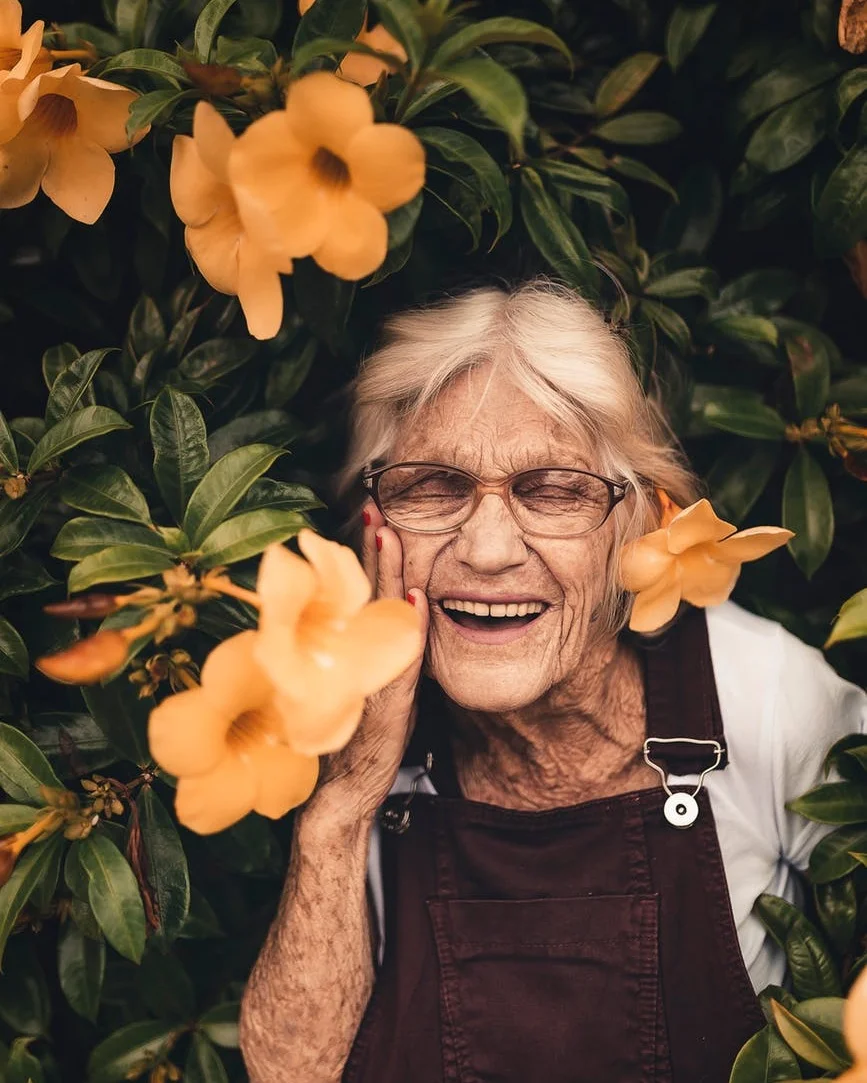
“You know, I’ll be eighty-six years old this year, and I try to find something to laugh about every day. Yeah, I know hard things happen in life and things don’t always go like we want, and some people think that gives them the right to grumble and be all miserable and nasty. But I’m old, and I know life is too short to live like that. I just brush those things off and don’t think about them and find something to laugh about instead. When I die, I’m going to do it with a smile on my face.”

With her final statement, she gave an emphatic nod and what I now surmised to be her characteristic grin. I couldn’t help but smile back at her, and I left the store that day still wearing that smile as I walked to my car. Her outlook on life was contagious. But on the way home, I started wondering if I could live like that all the time.

* * *

It is not difficult to see that life can be hard. We face the effects of its broken, not-yet-fully redeemed state every day. The newsreels remind us of conflicts, poverty, and injustice on a global scale. We see it in our own lives in sickness and ailing bodies, in severed relationships and the loss of those we love. Violence, want, and the delay of justice aren’t contained in one part of the globe or a particular neighborhood. They come knocking at our doors as well in myriad forms. Who among us can escape suffering and tears?

I do not believe faithfulness to Christ or a firm grasp on joy demand that we ignore this reality of the pain our existence can bring. We need look no further in the Bible than the Psalms of lament or a book such as Lamentations to see that we are given permission to mourn and to rail against the ways life is not as it should be. We do not need to simply brush our pain aside, to ignore it, to laugh it off. We can sit with our grief, rage, and tears and call it what it is. In fact, we are given permission to bring that grief and rage and those tears in astonishing honesty and rawness to God himself. Repression is not a sanctified action.

And yet. (There is always an “and yet,” isn’t there?) And yet, even in these places in the Bible that give voice to our deepest pain and longings, there is a space held open for rejoicing. This joy does not come because we ignore the parts of life that are hard. It comes because our faith gives us comfort in the midst of a life that is hard. We have hope that is anchored in who God is and in what He has promised. As I heard someone say recently, “I read the end of the book, and that’s why I can keep smiling.”

My store clerk was right—there is no space for grumbling and misery in the face of life’s difficulties. She was right that there is always space for joy. But that joy doesn’t come from blinding ourselves to the world’s ills or numbing our hearts against the painful situations that may come our way. Joy comes from a deep-seated belief that God is who He says He is and He will do what He said He will do. Faith allows us to stare down the hard parts of life while joy still takes root in our souls. This joy is realistic but irrepressible. It is joy that can survive in the dark. It is joy that allows us to die with a smile on our face.

Weakness Under the Spotlight

I stood in her kitchen, with the connecting presence of a mutual friend. She leaned into the kitchen cabinet with the ease of being at home. The warmth of the wood extended an invitation to stay awhile, to sit down with a cup of tea.

I could very much use a cup of tea in someone’s kitchen. We’d been wading through transition, plans, deadlines, and little sleep for months now. “They” say to only subject yourself to three major life events a year. Our list was six points long already, and autumn had only just begun. We could feel the weight of it all. Most of those events were good things—or at least good in part—but even the good piled on heavy. We were tired. Stress nibbled at the sleep our young daughter yielded to us, her nights and naps disrupted by changing places and schedules. My mind tried to keep track of all the details, the bills, the appointments, the tasks at hand, but it was hazy. My usually disciplined mind struggled to remember. I wrote lists and used them as an anchor for my days. It was the only way I knew how to wade through. I needed rest—for body, mind, and soul.

I tried to explain. I talked about our transition, about our life-event overload, about how ready we were to slow down, to settle, to be at home once again.

She smiled kindly. “Well, God puts us in situations like this…” (My mind was finishing her sentence. I started nodding my head.) “…to show us how strong we are.”

In the moment, I didn’t know what to say. They were not the words I was expecting. They weren’t the words my heart needed to hear. Caught off guard, without the relationship to offer the reasons I disagreed with her biblically, I smiled politely and left it alone. But since that afternoon, I’ve thinking about her words.

weakness+under+spotlight.jpg

If all of this is about how strong I am, I’m doomed. There are days I am propelled by a mere combination of duty and adrenaline, habit and love. It is sheer willpower, sheer commitment that keeps me going. There are days I cry from self-pity, I snap at my husband, and I don’t have the energy to call that friend I know I need to catch up with. If all of this is about how strong I am, I’m failing the test. This season is merely showing my own weakness. It’s full onstage, under a blinding spotlight for all to see.

Thank God, this whole enterprise of life is never about how strong I am. It’s always about the strength and mercy and grace of the God I serve. Always, always about Him. It’s about how His strength is made perfect in my weakness. It’s about how He always enters the mess to bless us undeservedly with His presence. It’s about how His grace extends over every lost temper, every moment of selfishness, every doubt of his provision.

As we read the Bible, we find again and again that God uses people who are weak. It’s part of the way He works—taking a unlikely person or an impossible situation and using it to show His glory. He made a post-menopausal woman a mother (Gen. 17, 21) and a disgraced outcast the first evangelist (John 4). He made a murderer into a songwriter whose words have blessed people for generations (see the Psalms). With the sound of His voice, He brought blood and oxygen flowing through the body of a days-old corpse (John 11). We read these stories in Scripture. We see them today.

In seasons when all is well, I am easily lured by a sense of my own self-sufficiency. It’s easy to think I have the power to keep it all together, to orchestrate the smooth running of my life, to meet everyone’s needs, to effortlessly keep up with all of life’s demands. But when challenges hit, when sleep runs low, when I’m swept up in transition or grief or sickness, that’s when I realize what a farce that idea is. That’s when I come face to face with my inability and my weakness. It’s when I acknowledge once again my dependence on God for all of my needs, for my strength, for the Holy Spirit’s empowerment to live a life of love and faith.

I hate the seasons when I feel out of control. I’d really rather the “gospel” that says they are intended to show me my own strength. But my soul desperately craves the Gospel that tells me I don’t have to just pull myself together, to find a way to be good enough, or to put on a show when I can’t so people don’t think less of me. I need to hear the Gospel that takes the focus off my weakness and turns my eyes to a Father who loves me as I am and as I’m becoming and to a Savior who provides all the strength that I lack. This is truly Good News.


This post is part of the series “The Gospel According to My Hairdresser.” I often hear personal “gospels” as I interact with people around me, in the messages they declare about life and faith and the maxims they find to be “good news.” This series explores these moments personally and biblically as I come to terms with how these “gospels” influence our lives as disciples and how they measure up to the Gospel of grace found in Jesus.

A Prayer for My Feet

I sat on a flimsy plastic stool, the same sort I’d propped on to eat street noodles a few days before. My eyes were closed, elbows resting on knees as I sat in a small circle of praying Christians. It was a little oasis during my week, a moment when I could relax my guard and enjoy the presence of other believers. I was enveloped by the prayers spoken into the room. There was peace here.

The middle-aged man beside me was praying, asking for the Lord’s protection, for provision, for wisdom in our work. He stopped suddenly. A pause? A moment for thought? An abruptly ended prayer?

I was confused when I opened my eyes slightly to peek at his face. It was contorted with emotion, his mouth tight, brow furrowed. The corners of his eyes were wet. What had he said that evoked such overwhelming emotion?

He continued, his voice thick. Father, let your Kingdom come in this place.

I’d heard these words oft-repeated in the Lord’s Prayer but never with so much desperation. Never before had I seen this petition for the Kingdom to come “on earth as it is in heaven” to bring a grown man to tears. I’d never thought its implications could be so profound. I couldn’t shake it.

I took his prayer with me to the streets of that remote corner of Asia: Father, let your Kingdom come. When I returned home at the end of that summer, I took it to the halls of my small Christian college, where so many of us were plagued with depression and perfectionism: Father, let your Kingdom come. It followed me to Central America, to rooms filled with sleeping foster children: Father, let your Kingdom come. It came with me to New England, and I carried it with me as I walked down our tree spotted street into town: Father, let your Kingdom come in this place.

prayer+for+my+feet.jpg

Along the way, I’ve found this prayer shaping me, as our prayers so often do. It wasn’t merely a request thrown to the heavens. It became a moment in which I positioned myself for God to mold me. It was a moment in which He met me.

You can only pray that prayer so long until you start asking questions about what the Kingdom of God looks like or how we recognize its coming. When we pray “let your Kingdom come,” it’s only a matter of time until we start asking what role we play in that request.

I grew up in a tradition that largely understood the Kingdom of God as a future other-worldly reality. It was about the salvation of souls, and it was something to be escaped to when the Kingdom’s King returned (or when I went to heaven when I died).

But over the years, as this little prayer burrowed deeper into my soul, I began to meditate on what it meant for heaven to come to earth. The hope of New Creation captured my heart. I began to long for and keep my eyes open not only for the Kingdom that is not yet, but also the Kingdom that is already breaking into our world, the Kingdom I have been welcomed into, the Kingdom I am an ambassador for.

In his book Surprised by Hope, N.T. Wright describes our current actions as signs of the Kingdom that has arrived in Jesus and foretastes of all that is to come. We are to be “new-creation people here and now, bringing signs and symbols of the kingdom to birth on earth as in heaven. The resurrection of Jesus and the gift of the Spirit mean that we are called to bring real and effective signs of God’s renewed creation to birth even in the midst of the present age.”

We long for the day when the Kingdom comes fully and finally to earth. But until then, we embody the nature of the Kingdom and seek to bring its marks to our spheres of influence. We seek justice and reconciliation, truth and peace, freedom and wholeness, the restoration and healing of bodies and of souls. We work and “build for” (Wright’s language) the Kingdom precisely because of our deeply rooted hope that our prayers for the Kingdom to come will one day be answered completely.

I’ve learned that praying for the Kingdom of God to come to earth as it is in heaven is not a prayer that can remain in the seclusion of a prayer closet. We carry it with us when engage in the work of reconciliation or when we care for trafficking victims. It’s there when we care for the homeless and welcome the poor, when we fight to protect the dignity and life of all humankind. It surrounds us as we have spiritual conversations with a non-Christian friend or we disciple a fellow Christian into a deeper understanding of God’s love for them. It leads us as we seek the good and flourishing of our neighborhoods and cities. It’s a prayer we pray on our feet.

Let's Build a Wall...Of Self-Care

Today’s post is a guest post from my dear friend Alison. She’s sharing with us some practical tips about how we can practice good self-care.

Although sometimes self-care can be painted as selfish (and, to be honest, I have seen some people use it as an excuse to be), I find that a healthy self-care practice, like the one Alison helps us think about here, is actually an important part of our discipleship. It helps us remember that we are finite, that we need rest, that we need other people. Good self-care can make us more effective as disciples of Jesus, better able to love God and love others. I hope you’re encouraged and challenged by what she has to share.

Alison is a pastor and a poet - and an integral part of my own “wall” of self-care for the gray New England winters. You can find her sermons on her church website and her occasional thoughts on her blog.

Enjoy!


bricks-167072_960_720.jpg

I don’t know about where you are, but where I am? It’s the most horrible time of the year. It’s overcast, it’s cold, it’s snowy, it’s icy, it’s gross. And gross weather means gross moods, gross feelings about oneself and one’s existence, and even, at times, gross walks with God.

Over the last eight winters living in New England I have learned that in order to protect myself against this madness, I need a good defense system. Like a wall. And not a wall where I block my friends out and don’t let them know what’s going on with me. And not a wall of blankets where I bundle myself in bed for the next two months. But a wall of self care. Like a defense system, built out of regular, healthy actions I take, to take care of myself.

But hang on a second, isn’t self care selfish? Isn’t it un-Christian? Isn’t it…wrong? No, it isn’t. Jesus instructed us to "love others" as we "love ourselves", as though loving ourselves was something he expected us to do naturally. And self care doesn’t mean we ignore everyone else or ignore God - taking care of others, and loving God is also part of a good self care system. Because those things, as well as being rewarding to God and to others, also are wonderfully rewarding to ourselves.

So how do you build a wall of self care? You do need to be intentional about this, and keep track of what you do. The best way I’ve found? With those excellent and ancient tools: the pen and the sheet of paper.

  1. Start out with a piece of graph paper, or even some kind of habit tracker like this one Ashley made as a free printable for her Evermore Paper Co blog.

  2. Make a list down the side of different activities that you can do during the day that help you take care of you. I try to make my list out of a variety of different activities that address the different needs I have: physical, emotional, social, intellectual, and spiritual needs.

  3. Keep track of what activity you do every day. Just before you go to bed, check off what you have done.

  4. The goal is not to do ALL the things every day - rather, to be consistently doing a few of them every day. These little bricks on your self-care chart make up the “wall" that you are building for yourself. A day with a solid group of bricks in it, is another notch in the wall built. A day with no bricks in it is where the defenses come down and some of those gross moods, gross thoughts, gross behaviors can creep in.

If it’s hard for you to think of what might constitute self care activities, I thought I would leave you with some suggestions. Don’t start with all of these on your chart, that would be overwhelming! Maybe two that really speak to you from each group?

Physical: go for a walk, go outside (can sometimes be hard in winter!), exercise for X minutes, dance for X minutes, drink X cups of water, eat some vegetables, eat some fruit, eat three meals, take a shower, brush your teeth, brush your hair, go to bed before Xpm, get 8 hours sleep

pexels-photo-274778.jpeg

Emotional: take a moment to be aware of what you are feeling, write in your journal, make a list of things that are stressing you out, make a list of things you are thankful for, visit a counselor, give yourself X quiet minutes alone, say no to something, say yes to something, take a thought that you keep having that’s really hurting you and tell it to go away, take something you keep beating yourself up about and forgive yourself

Social: call a friend, see a friend, write a card to a friend, pray for a friend, give a gift to somebody, go on a date, have some intentional play time with your kids

Intellectual: read a book, read the paper, look at some art, listen to music, play some music, watch a movie, do a crossword, work on a project

Spiritual: listen to worship music, memorize a bible verse, read the bible, pray

Of course, what constitutes good self care for you might be completely different to what it means for me. If you have any other suggestions for items other people can put on their Wall of Self Care Chart, leave them in a comment below.

Happy building, all!